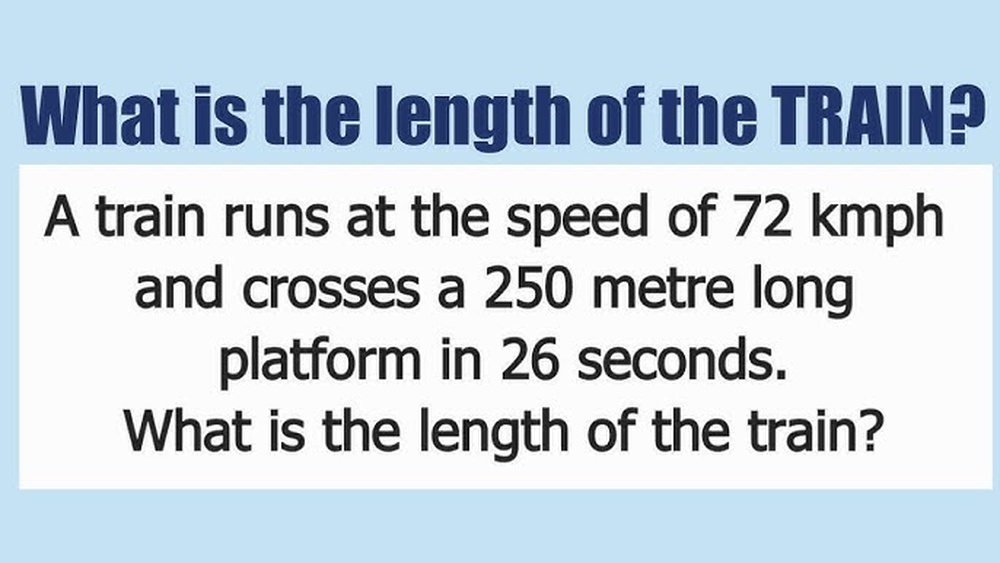
Have you ever wondered how long it takes for a train moving at 72 km/h to completely cross a platform? It’s a question that might seem simple at first, but it actually involves some interesting calculations and concepts.
Whether you’re a student preparing for exams, a curious learner, or just someone who loves trains, understanding how to solve this problem can sharpen your problem-solving skills and boost your confidence. You’ll discover easy-to-follow steps and tips to figure out how a train crosses a platform, making a tricky physics problem much clearer.
Ready to unlock the mystery behind trains and platforms? Let’s dive in!
Train Speed Basics
Understanding train speed is important for many calculations.
It helps find time taken to cross platforms or other objects.
Speed tells us how fast the train moves on the track.
Converting Kmph To M/s
Speed is often given in kilometers per hour (kmph).
For physics problems, meters per second (m/s) is easier to use.
To convert kmph to m/s, multiply the speed by 5 and divide by 18.
Example: 72 kmph × (5 ÷ 18) = 20 m/s.
This conversion helps solve train crossing problems quickly.
Why Speed Matters
Speed affects how long a train takes to cross a platform.
Higher speed means less time to cross the same distance.
Knowing speed helps calculate train and platform lengths.
It also ensures safe train operations and scheduling.

Credit: www.youtube.com
Platform Crossing Explained
When a train crosses a platform, it covers more distance than just its own length. The total distance equals the train’s length plus the platform’s length. The train speed and these lengths decide how long it takes to cross fully. Understanding this helps in solving many physics and real-life problems. Let’s explore the key points to calculate crossing time.
Train And Platform Lengths
The train length is the distance from its front to its end. The platform length is the full stretch of the platform. The train must pass completely beyond the platform edge for crossing to finish. This means the train travels a distance equal to the sum of both lengths. Knowing these lengths is essential before calculating the crossing time.
Calculating Crossing Time
First, convert the train speed into meters per second. Use the formula: speed (m/s) = speed (km/h) × 1000 ÷ 3600. Next, add the train length and platform length to get total distance. Divide this total distance by the speed to find the time taken to cross. This method gives a clear, step-by-step way to find crossing time.
Speed And Timing Formulas
Several factors influence the time a train takes to cross a platform. Understanding these factors helps in calculating the crossing time accurately. The train’s speed, the length of the train, and the platform’s size all play important roles. Each factor affects how long the train stays alongside the platform during crossing.
Train Length Variations
The length of the train directly affects crossing time. A longer train takes more time to clear the platform. Shorter trains cross platforms faster. Train length changes depending on the number of carriages. More carriages mean a longer train and increased crossing time.
Platform Length Differences
Platform length varies from one station to another. Longer platforms require more time to cross. Short platforms reduce the crossing duration. The total distance to cover is the sum of train length and platform length. A longer platform increases the total crossing distance, extending the time.
Speed Changes
The speed of the train is a key factor in crossing time. Faster trains cross platforms more quickly. Slower speeds increase the crossing duration. Trains may change speed due to signals or curves near platforms. Speed adjustments directly impact how fast the train completes the crossing.

Credit: en.wikipedia.org

Credit: en.wikipedia.org
Frequently Asked Questions
What Is The Time Taken By The Train To Cross The Platform?
The time taken depends on the train’s speed and the platform’s length. Use the formula: Time = (Train length + Platform length) / Speed. Convert speed into meters per second for accurate calculation.
How To Calculate Platform Length When Train Speed Is Known?
Platform length can be found by rearranging the crossing time formula: Platform length = (Time × Speed) – Train length. Ensure all units are consistent, typically meters and seconds, for precise results.
Why Is Train Speed Converted To M/s In Calculations?
Speed is converted to meters per second (m/s) because distance is measured in meters and time in seconds. This unit consistency is essential for accurate calculations in physics problems involving trains and platforms.
Can A 72 Kmph Train Cross Any Platform In The Same Time?
No, crossing time varies with platform length. A longer platform increases crossing time, even if train speed is constant. Each calculation must consider both train and platform lengths.
Conclusion
A train traveling at 72 kmph crosses a platform in a set time. Knowing the train’s speed and crossing time helps calculate platform length. This simple physics problem shows how speed and distance relate. It offers a clear example for learners to understand motion concepts.
Remember, breaking down problems step-by-step makes solving easier. Practice these problems to improve your physics skills. Understanding these basics builds a strong foundation for more complex topics. Keep learning and exploring how everyday situations involve physics.