
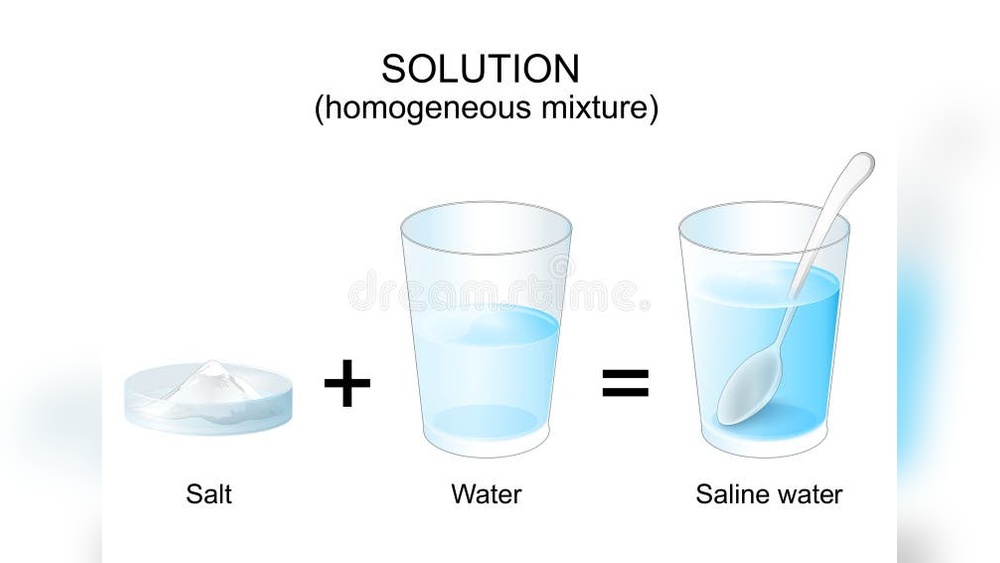
Have you ever wondered what really happens when you mix salt and water? Is it just a simple blend, or does it create something more special—a solution?
Understanding this can change the way you see everyday things like cooking, cleaning, or even science experiments. You’ll discover why mixing salt and water is more than just stirring two ingredients together. By the end, you’ll know exactly what makes saltwater a solution and why it matters in your daily life.
Ready to unlock the secrets behind this common mixture? Keep reading!

Credit: www.shutterstock.com
Salt Water As A Solution
The dissolution process explains how salt mixes with water to form a solution. It involves breaking down salt crystals and spreading them evenly in water. This process happens at the molecular level and makes the mixture appear uniform. Understanding dissolution helps us see why saltwater acts as a solution.
Salt, or sodium chloride, consists of charged particles called ions. These ions separate and interact with water molecules during dissolution. Let’s explore the key steps in this process.
Ionic Separation In Salt
Salt is made of sodium and chloride ions held tightly together. When salt meets water, these ions begin to separate. Water molecules pull the positive sodium ions and negative chloride ions apart. This separation breaks the solid salt into individual charged particles. It is the first step to dissolving salt in water.
Interaction With Water Molecules
Water molecules surround the separated ions. The positive end of water attracts chloride ions. The negative end attracts sodium ions. This attraction keeps ions from joining back together. Water acts like a shield, holding ions apart and stable in the solution. This interaction helps salt dissolve fully in water.
Molecular Dispersion
Once separated and surrounded by water, ions spread out evenly. They move randomly throughout the water, creating a uniform mix. This even spread of salt ions in water is called molecular dispersion. It makes the salt invisible and the solution clear. Molecular dispersion ensures the saltwater stays consistent and well-mixed.
Dissolution Process
Understanding the difference between a solution and a mixture helps clarify what happens when salt mixes with water. Both terms describe combinations of substances, but they are not the same. A solution is a special type of mixture that looks uniform and has particles evenly spread out. This section explains the key traits of solutions and compares them to mixtures to see where salt water fits.
Characteristics Of Solutions
Solutions have particles of solute dissolved completely in the solvent. The mixture appears clear and uniform throughout. The solute does not settle or separate over time. Particles in a solution are too small to be seen with the naked eye. Solutions do not scatter light, so they look transparent. They cannot be separated by simple filtering or settling. Salt water shows all these features because salt dissolves fully in water.
Differences From Heterogeneous Mixtures
Heterogeneous mixtures have visibly different parts or layers. You can often see or separate the components easily. The particles are larger and do not dissolve completely. These mixtures scatter light and look cloudy or uneven. Examples include sand in water or oil and water. Unlike solutions, heterogeneous mixtures separate over time. Salt water does not separate, so it is not heterogeneous.
Salt Water Classification
Salt water is classified as a homogeneous mixture or a solution. Salt acts as the solute and water as the solvent. Salt dissolves evenly at the molecular level in water. This creates one phase that looks the same everywhere. Salt water does not show different layers or particles. It remains stable unless the water evaporates, leaving salt behind. This makes salt water a classic example of a solution.
Solution Vs Mixture
Understanding physical and chemical changes helps us know what happens when salt mixes with water. Physical changes affect the form or appearance but not the substance itself. Chemical changes create new substances with different properties. Mixing salt and water shows interesting examples of both types of changes.
Dissolving Salt As A Physical Change
Dissolving salt in water is a physical change. The salt breaks into tiny particles and spreads evenly. The salt still keeps its chemical identity. No new substance forms in this process. The mixture looks clear and uniform. This type of mixture is called a solution.
Evaporation Effects
When water evaporates, it changes from liquid to gas. This is a physical change because no new substance forms. Salt does not evaporate. It stays behind as solid crystals. Evaporation can separate salt from water. The salt can be collected after all water leaves.
Mass Change Observations
Measuring the mass before and after mixing shows important clues. The total mass stays the same when salt dissolves. No mass is lost or gained. After evaporation, the mass decreases as water leaves. The salt mass remains constant. These observations confirm dissolving and evaporation are physical changes.

Credit: en.wikipedia.org
Physical And Chemical Changes
Many people have wrong ideas about what happens when salt mixes with water. These misunderstandings can confuse learners and everyday readers. It is important to clear up these myths. Understanding the true nature of salt water helps us grasp basic science concepts better.
Salt and water create a mixture, but not everyone agrees on what type. Some think salt water is a new substance. Others argue about the kind of change that occurs. Let’s explore these common misconceptions.
Is Salt Water A Compound?
Salt water is not a compound. A compound forms when elements combine chemically. Salt and water do not form new molecules together. Instead, salt dissolves into water, spreading its particles evenly.
This mixture is called a solution. The salt particles stay separate but very small. They are mixed at the molecular level. The water remains water. No chemical bonds form between salt and water molecules.
Chemical Change Debate
Some say mixing salt and water causes a chemical change. This is not true. Dissolving salt in water is a physical change. The salt breaks into tiny pieces but keeps its identity.
A chemical change would create a new substance. For example, burning wood turns it into ash and gas. Salt water can be separated again by evaporation. This shows no new chemical was made.
Clarifying Scientific Perspectives
Scientists agree salt water is a homogeneous mixture. It looks the same everywhere in the cup. No new chemical formula forms here. This mix is stable and reversible.
Understanding these facts helps avoid confusion. Salt water is a solution, not a compound. Its formation involves physical changes, not chemical reactions.
Credit: www.istockphoto.com
Frequently Asked Questions
Is Salt And Water A Solution?
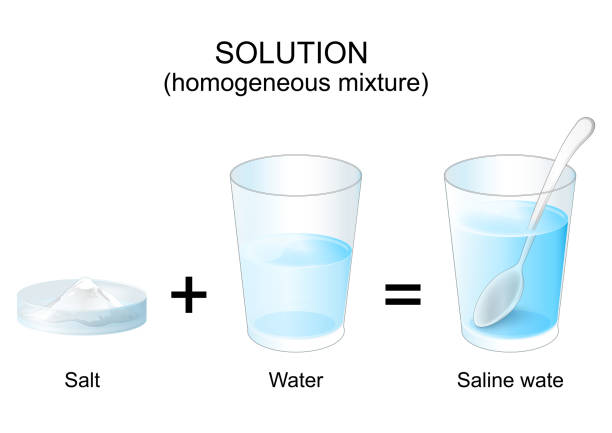
Yes, salt and water form a solution. Salt dissolves evenly in water, creating a clear, uniform mixture called a homogeneous solution.
What Is A Mixture Of Salt And Water Called?
A mixture of salt and water is called a saltwater solution. Salt dissolves evenly, forming a homogeneous mixture.
What Kind Of Change Is Mixing Salt With Water?
Mixing salt with water creates a physical change called a solution. Salt dissolves evenly, forming a homogeneous mixture without altering chemical properties.
What Type Of Change Is Dissolving Salt In Water?
Dissolving salt in water is a physical change. Salt dissolves, forming a homogeneous mixture without altering chemical composition.
Conclusion
Mixing salt and water creates a clear, uniform solution. Salt dissolves evenly, spreading throughout the water. This mixture looks the same everywhere you check. It is not a chemical change but a physical one. Salt can be recovered by evaporating the water.
This simple process shows how solutions work daily. Understanding this helps explain many science and cooking tasks. Saltwater is a perfect example of a basic, useful solution.


